
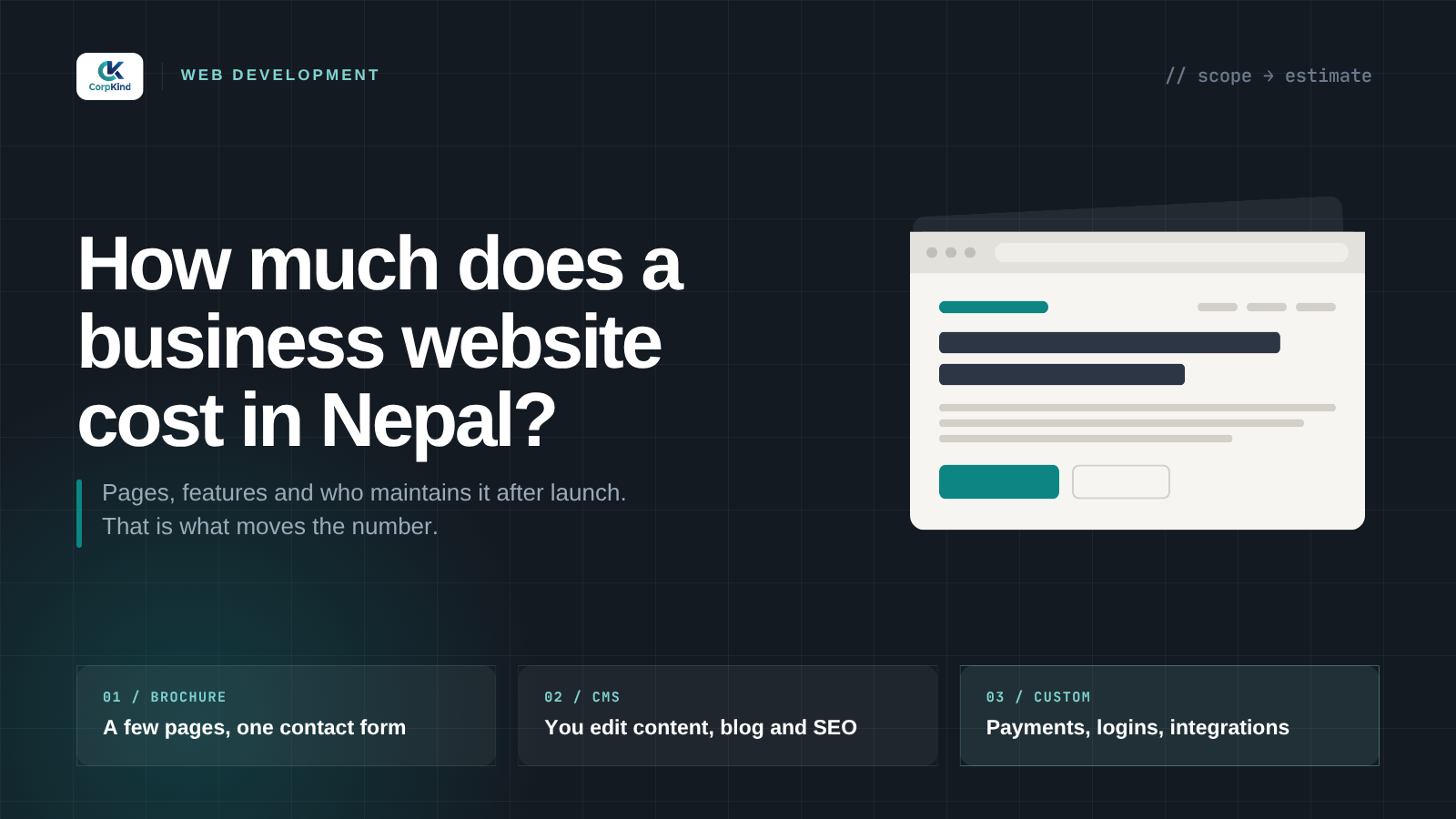
Ask three developers what a website costs and you will get three very different numbers. That is not because someone is lying, it is because a website is not one fixed thing. What you pay depends on how big the site is, how much of it is custom, and what it needs to do. Here is a plain guide to what actually drives the cost of a business website in Nepal, and the costs people forget until the bill arrives.
What drives the price of a website
- Number of pages: a five-page site is a different job from a twenty-page one. More pages means more design, content, and testing.
- Template or custom design: starting from a premium theme is faster and cheaper. A bespoke design built around your brand costs more because it takes more work.
- Features: a simple brochure site is one thing. Booking flows, enquiry forms, multi-language, member logins, or a blog all add scope.
- E-commerce: selling online adds a product catalog, cart, inventory, and order management, so a store costs more than a standard site.
- Content: if you provide the text and photos, that is cheaper. If the developer writes copy and sources images, that is extra work.
- SEO and speed: a site built to be found on Google and to load fast takes more care than one just thrown online.
The costs people forget
The build is only part of the picture. A few things sit outside the development price, and a good developer will be upfront about them:
- Domain name: your web address, renewed yearly.
- Hosting: where the site lives, paid monthly or yearly, sized to your traffic.
- Payment gateways: if you take payments, gateways like eSewa, Khalti, Fonepay, or Stripe run on your own merchant accounts.
- Third-party tools: a CRM, email, or SMS service is usually a separate subscription.
- Ongoing maintenance: updates, backups, and small changes after launch.
Why “development-only pricing” is a good sign
Here is a quiet detail that separates an honest quote from a padded one. The domain, hosting, gateways, and paid tools above should be set up on your accounts, in your name, not bundled into the developer’s price and marked up. When they sit with you, you own them, you can see what they really cost, and you are never locked in.
This is how we price web work: development-only, with those four things provisioned on your accounts. It keeps the number honest and keeps you in control. If a quote rolls everything into one vague figure, ask what happens to your domain and hosting if you ever change developer. The answer tells you a lot.
What you get at different levels
Roughly, business websites fall into a few tiers:
- Starter: a small, responsive site of around five pages, a contact form, and basic SEO. Good for a new business or single-service brand that needs a professional presence.
- Business: a larger site with custom design direction, a blog, fuller SEO, and analytics. For an established business that wants a real presence and to be found.
- Professional: a bespoke, lead-focused site with more pages, advanced SEO, and enquiry or booking flows.
- E-commerce: an online store with a product catalog, cart, and order management, ready to connect to payment gateways.
The right tier depends on what the site is for, not on picking the biggest one.
One-time build vs ongoing cost
Most of the cost is the one-time build. After that, you have small recurring costs: domain and hosting, any subscriptions, and optional maintenance. A good build also comes with a support window after launch, so bugs and tweaks in the first weeks are handled without a new invoice.
The real red flag: vague pricing
The number matters less than whether the quote is clear. A good quote lists exactly what ships: how many pages, what features, what is and is not included. That is what stops scope creep and surprise line items at the end. If you cannot tell what you are getting, you cannot tell if it is a fair price.
How to get an accurate number
The only honest way to price a website is to talk about what you actually need first. We start with a short scoping call about your goals, audience, and must-haves, then recommend the tier that fits and send a fixed quote, in NPR, with everything listed. See our web development packages, or book a scoping call and we will give you a clear number.
Common questions
Is a cheap website worth it?
Sometimes, if the scope genuinely matches your needs. But a cheap price often hides missing SEO, poor speed, no support, or a lock-in on your domain and hosting. Compare what ships, not just the number.
Do I pay for hosting and domain separately?
Yes, and that is a good thing. Hosting, domain, and payment gateways should be on your own accounts so you own them and are not overcharged. A developer can set them up for you without padding the build price.
What ongoing costs should I expect after launch?
Domain and hosting renewals, any third-party subscriptions you use, and optional maintenance for updates and changes. The build itself is a one-time cost.
