

At some point every growing business hits the same question: do we hire someone to run our IT, or hand it to an outside team? Both work. They just suit different situations. Here is a plain comparison of in-house IT vs outsourced IT for a business in Nepal, so you can pick the one that actually fits your team.
The honest trade-off
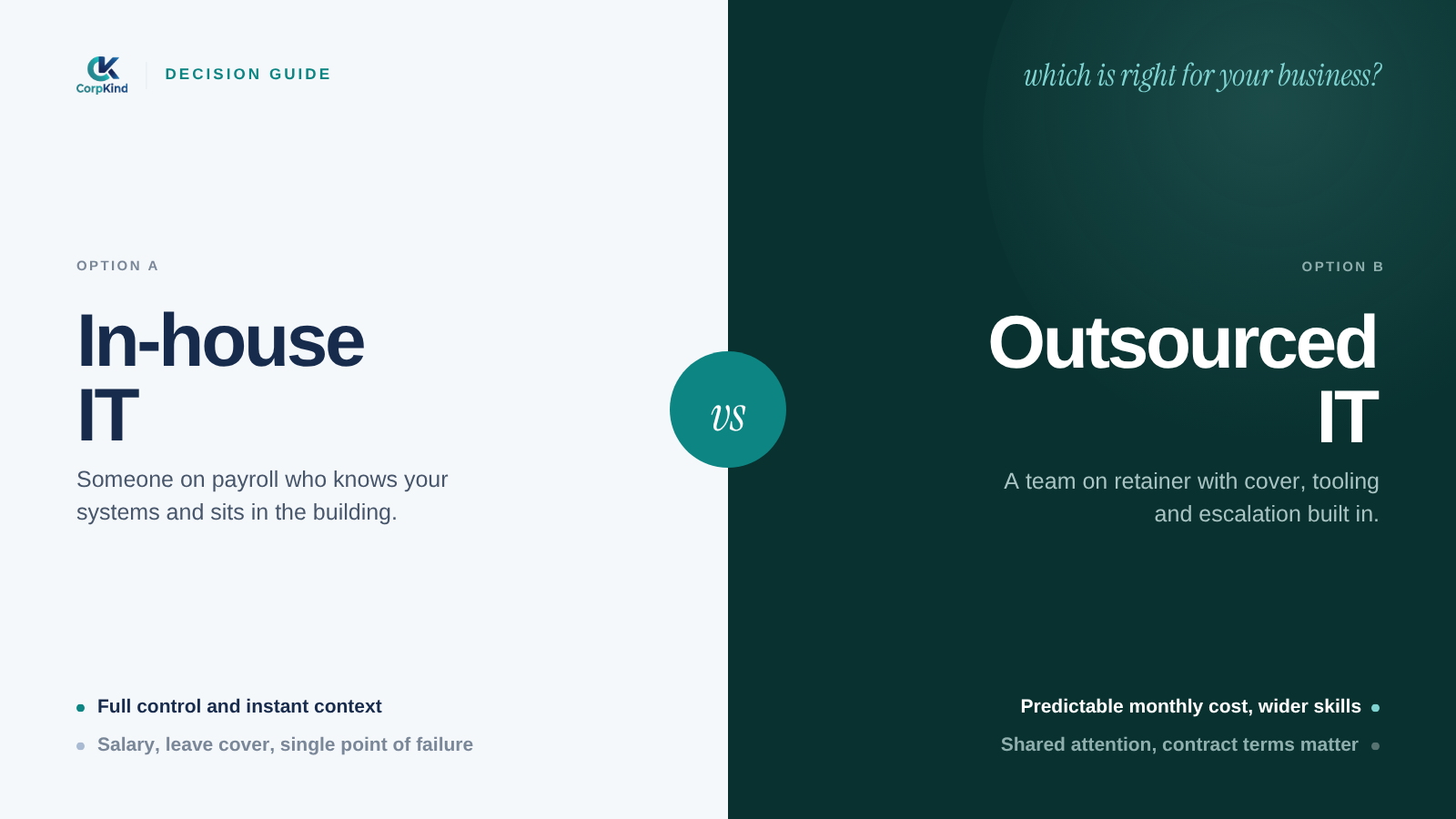
An in-house hire is one person who sits with you and knows your business inside out. An outsourced team is a group of specialists you share with other companies. One gives you presence and focus. The other gives you breadth and cover. The right answer depends on how big you are, how complex your setup is, and how much downtime would hurt.
What in-house IT gives you
- Someone on site: a familiar face who knows every quirk of your office and staff.
- Full focus: their whole day is your business, not shared with anyone else.
- Fast walk-up help: for hands-on problems, having a person in the building is hard to beat.
The catch: one person is one skill set. They cannot be an expert in servers, security, networks, and cloud all at once. They work office hours, they take leave, and if they resign, your knowledge walks out with them.
What outsourced IT gives you
- A whole team, not one person: helpdesk, security, servers, and networks, each handled by someone who does it every day.
- Cover that does not take leave: support keeps running when any one engineer is out, and can extend to nights and weekends.
- Tools and process built in: monitoring, patching, backups, and security come as standard, not as something one person has to set up alone.
- Predictable cost: a monthly fee instead of a salary plus tools plus training.
The catch: they are not sitting in your office all day, so outsourced support leans on remote help plus scheduled or on-call visits. A good provider makes that seamless. A cheap one leaves you waiting.
The cost question
People assume in-house is cheaper because it is one salary. But that one salary buys one skill set, and you still pay separately for security tools, backup, and training. An outsourced team spreads a full set of specialists and tools across a single monthly fee, which for most small and medium businesses works out to less than the cost of one senior hire. We break this down in how much managed IT costs.
When in-house makes sense
- You are large enough to keep a full IT team busy and fund their tools.
- You have specialised, always-on systems that need someone dedicated.
- Physical, hands-on work is a daily need, not an occasional one.
When outsourced makes sense
- You are a small or medium business that cannot justify a full IT department.
- You want broad expertise, not a single generalist.
- You want predictable costs and support that does not disappear when one person is on leave.
You can also do both
Plenty of growing companies run a hybrid: one internal person for day-to-day, hands-on needs, backed by an outsourced team for security, servers, and the specialist work one person cannot cover alone. Your in-house person stops being a single point of failure, and gets a whole team behind them.
Not sure which fits?
We help businesses in Nepal work out the right model, whether that is fully outsourced, or supporting an in-house person you already have. See how our managed IT service works, or tell us about your setup and we will give you a straight recommendation.
Once you have decided to bring in an outside team, the next step is picking the right one. We cover it in how to choose a managed IT company in Nepal.
Common questions
Is outsourced IT cheaper than hiring?
For most small and medium businesses, yes. One monthly fee covers a full team and the tools, which usually costs less than one senior salary plus the software and training an in-house person needs.
Can outsourced IT work alongside my existing IT person?
Yes. A common setup is to keep your in-house person for hands-on work and add an outsourced team for security, servers, and specialist tasks, so nobody is a single point of failure.
How fast is outsourced support if no one is on site?
Most issues are fixed remotely within a set response time, and a good provider includes scheduled or on-call visits for anything hands-on. Check the response times before you sign.
