

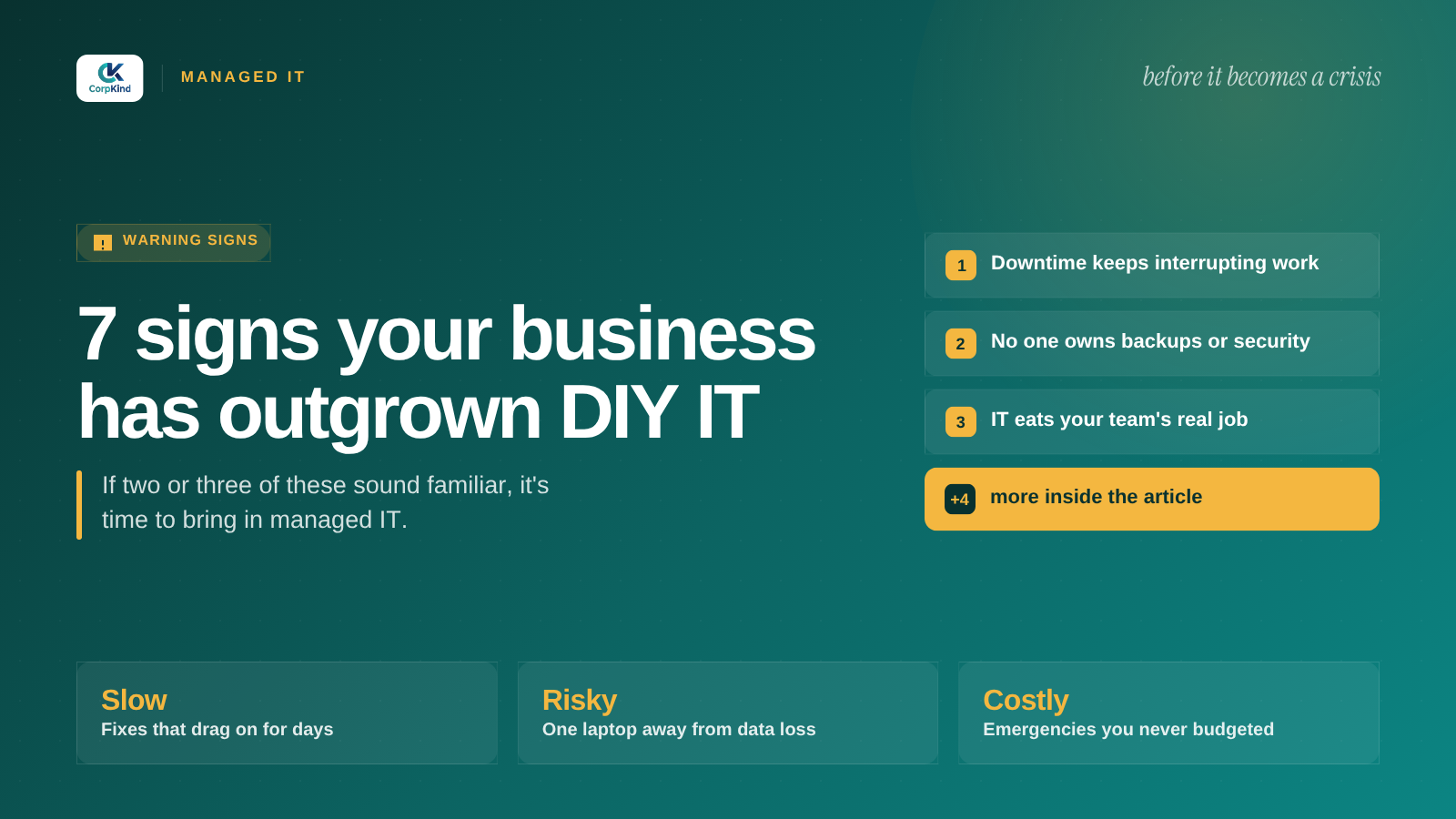
Most businesses do not decide to get serious about IT. They reach a point where the mess is costing too much to ignore. The trouble is that the warning signs build up slowly, so they are easy to explain away until an outage or a lost file forces the issue. Here are the clear signs your business needs managed IT support, so you can act before something breaks rather than after.
1. The same problems keep coming back
If email drops, computers slow down, or the Wi-Fi fails on a regular basis, and each time someone patches it just enough to limp on, you do not have a run of bad luck. You have unaddressed root causes. Managed IT exists to find and fix those, not to keep applying the same temporary patch.
2. No one actually owns your IT
When something breaks, does everyone look around the room? If IT is handled by whoever is least busy, a friend of the owner, or the one staff member who is “good with computers,” then no one is really responsible for it. That works until it does not, usually at the worst time.
3. You are not sure your backups work
Plenty of businesses have backups. Far fewer have ever tested restoring from one. If you cannot say with confidence that you could get your files and email back after a failed drive or a ransomware hit, you are running without a safety net. This alone is reason enough to bring in a real provider.
4. Support is slow, or you dread calling
If getting help means waiting days, chasing a freelancer who may or may not reply, or explaining your setup from scratch every time, your current arrangement is costing you hours it should be saving. Managed IT gives you a number to call and an engineer who already knows your systems, with a response time in writing.
5. You keep getting surprise bills
Break-fix bills arrive with no warning and no pattern. If IT is an unpredictable cost you cannot budget for, a managed plan turns it into a steady monthly line, and usually a lower one once you count the downtime. We compared the two in managed IT versus break-fix.
6. Security is an afterthought
No proper antivirus across devices, shared or weak passwords, no email filtering, or software that has not updated in months. Most breaches walk through an open door rather than a clever hack, and the businesses that get hit are rarely the ones that thought it would happen to them.
7. You are growing faster than your setup
New staff, a second office, more customers, more data. A setup that worked for five people strains at fifteen. If onboarding a new hire means a scramble for a laptop and logins, your technology is holding the business back instead of carrying it.
8. Your team is doing IT instead of their jobs
When capable people lose hours wrestling with printers, licences, and logins, you are paying skilled staff to do work an IT team would handle in minutes. That is one of the quietest and most expensive costs of having no real IT support.
What to do about it
If more than a couple of these sound familiar, it is worth a proper look. The next step is not a big commitment, it is understanding what you actually need. Start with what managed IT services include, and when you are weighing providers, how to choose a managed IT company in Nepal covers the questions to ask.
Start with a free audit
We run managed IT for businesses across Nepal, and every engagement starts the same way: a free IT audit. We walk through what you run, where the risks are, and the three things we would fix first, and you keep that whether or not you hire us. See our managed IT service, or tell us what has been going wrong and we will give you a straight answer.
Common questions
How do I know if my business is big enough for managed IT?
It is less about size and more about dependence. If your business would lose money or customers when technology goes down, or you hold data you cannot afford to lose, you are big enough to benefit, even with a small team.
We already have someone who handles IT. Do we still need a provider?
Often the two work together. A managed provider can take the routine monitoring, patching, and backups off your internal person so they focus on the business, and provide cover and depth they cannot give alone. We cover this in in-house versus outsourced IT.
What is the first step if we think we need help?
A free IT audit. It costs nothing, it does not commit you to anything, and it gives you a clear picture of your risks and the fixes worth making first. From there you can decide what, if anything, to do next.
