When you commission a website, one early decision shapes everything after it: build it on WordPress, or have it custom-coded from scratch. Both are good choices, for different jobs. Pick wrong and you either overpay for complexity you never use, or outgrow a setup that cannot keep up. Here is a plain comparison of WordPress vs a custom website for a business in Nepal.
What WordPress is good at
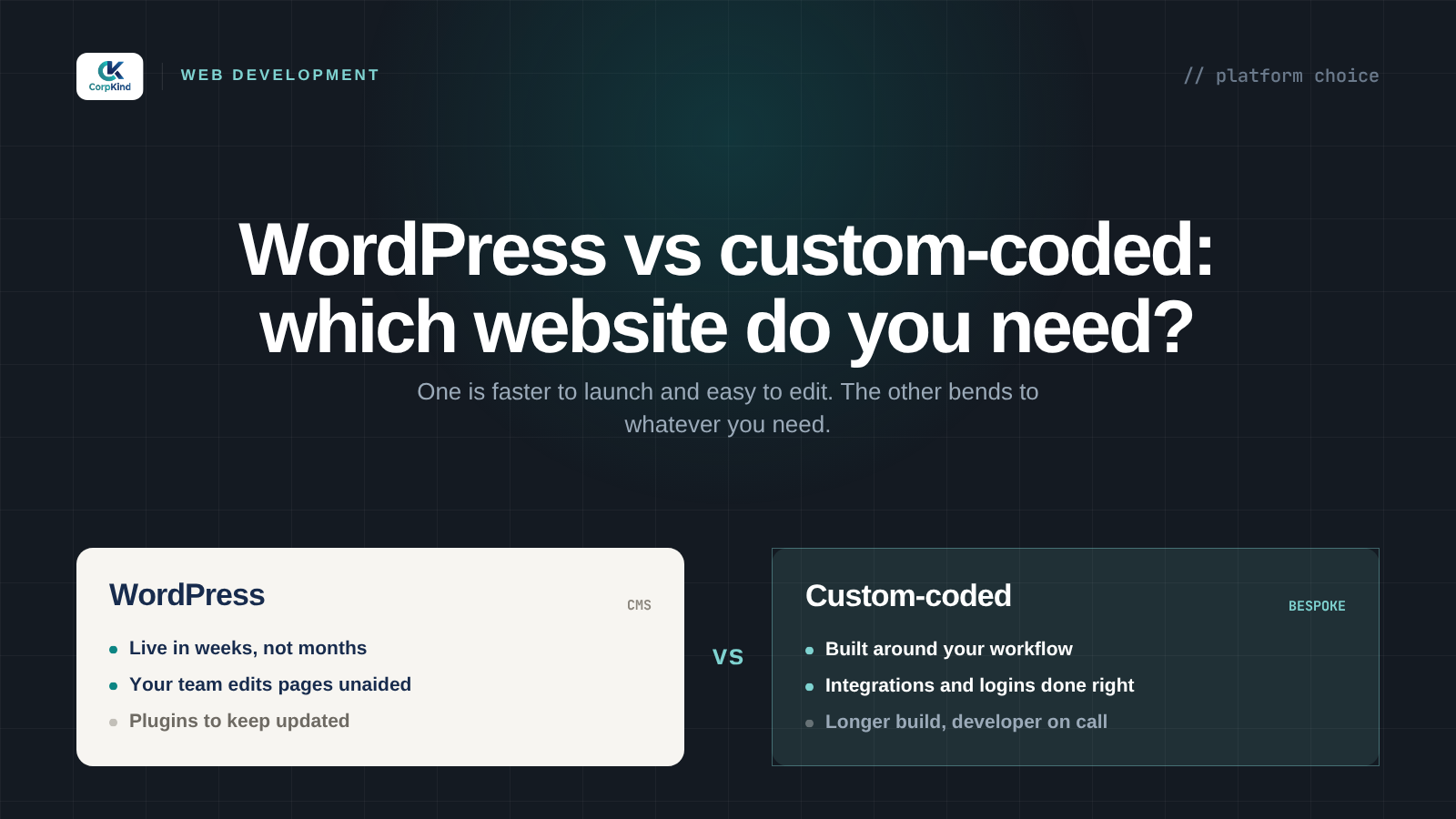
WordPress powers a large share of the web for good reason. For most business sites it is the practical choice:
- You can edit it yourself: update text, add blog posts, swap images, without calling a developer for every change.
- Faster and more affordable to build: a huge ecosystem of themes and plugins means less is built from zero.
- Proven for content and SEO: blogs, service pages, and on-page SEO are well-trodden ground.
- Easy to find help for later: plenty of people know WordPress, so you are never stuck with one developer.
The trade-off: plugins need updating and maintenance, and a poorly built WordPress site can get bloated. Built well and kept tidy, it serves most businesses for years.
What a custom-coded site is good at
A hand-coded site, built on a modern framework, makes sense when the job has specific demands WordPress would fight against:
- Top-end speed and performance: when every millisecond of load time matters.
- A bespoke product or app-like experience: custom flows, dashboards, or logic that go beyond a standard website.
- Scale and specific integrations: tying tightly into other systems, or handling very high traffic.
The trade-off: it costs more to build, changes usually go through a developer, and you need a team that can maintain it. You pay for power you should actually be using.
A simple way to choose
- Standard business site, blog, service pages, you want to edit content yourself: WordPress.
- Online store selling in Nepal: WordPress with WooCommerce is usually the pragmatic choice.
- A bespoke platform, unusual performance needs, or app-like features: custom-coded.
Most businesses are best served by WordPress. Custom-coding is the right call for a minority with specific needs, and a good developer will tell you honestly which camp you are in rather than selling you the more expensive option by default.
The thing that matters more than the platform
Whichever you choose, the same rule holds: you should own it. Your domain, hosting, and any payment gateways belong in your name, on your accounts, so you are never locked in and can move if you need to. A platform choice is reversible. Losing control of your own website is not. We cover this in how to choose a web developer.
How we decide with you
We are stack-agnostic: we build on WordPress or hand-code on a modern framework, and we recommend the one that fits your job, not the one we feel like building. It starts with a scoping call about what the site needs to do. Not sure what it will cost either way? See what a business website costs. Or explore our web development service, and tell us what you are building.
Common questions
Is WordPress good enough for a business website?
For most businesses, yes. It handles service pages, blogs, SEO, and even online stores well, and you can edit it yourself. Custom-coding is only needed for specific performance or product requirements.
Is a custom website better than WordPress?
Not better, different. Custom-coding wins on top-end performance and bespoke features but costs more and is harder to maintain. WordPress wins on speed of build, editability, and cost for a standard site.
Can I move my site from one to the other later?
Yes, though it is a rebuild rather than a switch. The more important thing is owning your domain, hosting, and content so you are free to move at all.
